Recent Trends and Advances in the Removal of Dyes from Industrial Wastewater Using Low Cost Adsorbents
Ravi Manne *
Chemtex Environmental Lab, Port Arthur, Texas-77642, USA.
*Author to whom correspondence should be addressed.
Abstract
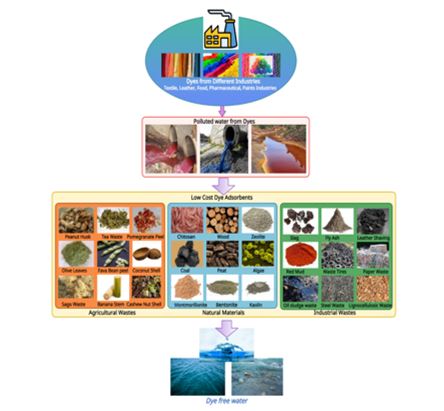
Dyes are complex class of organic compound having wide range of applications in textile and food industries and a large amount of dyes are wasted, which get mixed in natural water resources, and pollute environment. Mixing of dyes in water resources must be prohibited for the safety of natural ecosystem. Dyes are used for coloring textiles, wool, leather, paper and fibers. Natural dyes like indigo have been in use for over 5000 years. Natural dyes are replaced by synthetic dyes because of their low cost and vast range of new colors. Today, there are more than 10,000 dyes with different chemical structures available commercially. The natural and modified adsorbents are being successfully used for the adsorption of dyes from wastewater. Importance of several adsorbents like industrial waste, agricultural waste and clay adsorbents of both raw and modified for adsorption of dyes from textile wastewater has been highlighted in this review article. In this review we cover the regeneration capacity and adsorption efficiency of different adsorbents for the treatment of industrial dyes to control water pollution. We also reviewed wide variety of techniques and materials that have been used to remove organic pollutants from water. some adsorption techniques are cost-effective, ecofriendly, clay-supported adsorbents are widely because if their simplicity and good efficiency.
Graphical Abstract:
Keywords: Wastewater treatment, dye removal, adsorbents, cost effective adsorbents, pollution control