Amalgamation of Novel Schiff Base Ligand and Its Transition Metal Complexes and Their Biological Activity
B. Akila *
PG & Research Department of Chemistry, The Madura College, Madurai, Tamil Nadu, India.
A. Xavier
PG & Research Department of Chemistry, The Madura College, Madurai, Tamil Nadu, India.
*Author to whom correspondence should be addressed.
Abstract
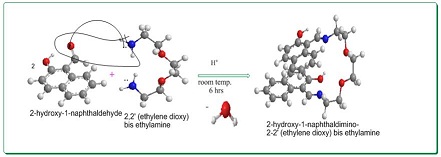
Schiff base synthesized from 2-hydroxy-1-naphthaldehyde and 2-2’ (ethylene dioxy) bis ethylenediamine (L1) and its Metal complexes, [M (II) (L)6](where M= Mn(II), Ru(III), Cu(II)and V(V) L= Schiff base moiety), have been prepared and characterized by elemental analysis, spectroscopic measurements (infrared, electronic spectroscopy, 1H-NMR, EPR and Mass spectroscopy ). Elemental analysis of the metal complexes was suggested that the stoichiometry ratio is 1:1 (metal-ligand). The electronic spectra suggest an octahedral geometry for MC1and MC2 Schiff base complexes and distorted octahedral for MC3 and MC4 complexes. The Schiff base and its metal chelates have been screened for their invitro test antibacterial activity against three bacteria, gram-positive (Staphylococcus aureus) and gram-negative (Klebsiella pheneuammonia and Salmonella typhi). Two strains of fungus (Aspergillus niger and Candida albicans). The metal chelates were shown to possess more anti fungal activity compare then antibacterial activity and antioxidant properties. The complexes are highly active than the free Schiff-base ligand.
Keywords: Schiff base, transition metal complexes, spectroscopic, biological activity, antioxidant study.